
Plantation Shutters vs. Window Film: Two Different Jobs, One Honest Comparison
Residential window film gets pitched hard in Arizona, and the pitch isn't wrong: film rejects real heat, invisibly, all the time. So why doesn't every home just tint the glass and call it done? Because a window does more jobs than blocking heat - and film only does one of them. Here's the fair version of this comparison, including the warranty fine print that most pages get wrong in both directions.
The quick verdict
Film and shutters aren't really competitors - film is a glass upgrade, shutters are a window treatment. Film's case is genuine: always-on rejection of a meaningful share of solar heat and nearly all UV, with zero view loss and nothing visible in the room. But that's where its job ends. It offers no privacy - and reversed visibility at night - no light control, no insulation after sundown or in winter, and nothing for the room's design or the home's resale. Shutters do all five of those jobs, plus serious heat performance of their own, worry-free for decades. Where heat and fade are the only problems on view-critical glass, film competes. Everywhere people actually live, shutters do the work - and on the hardest exposures, the two stack perfectly well.
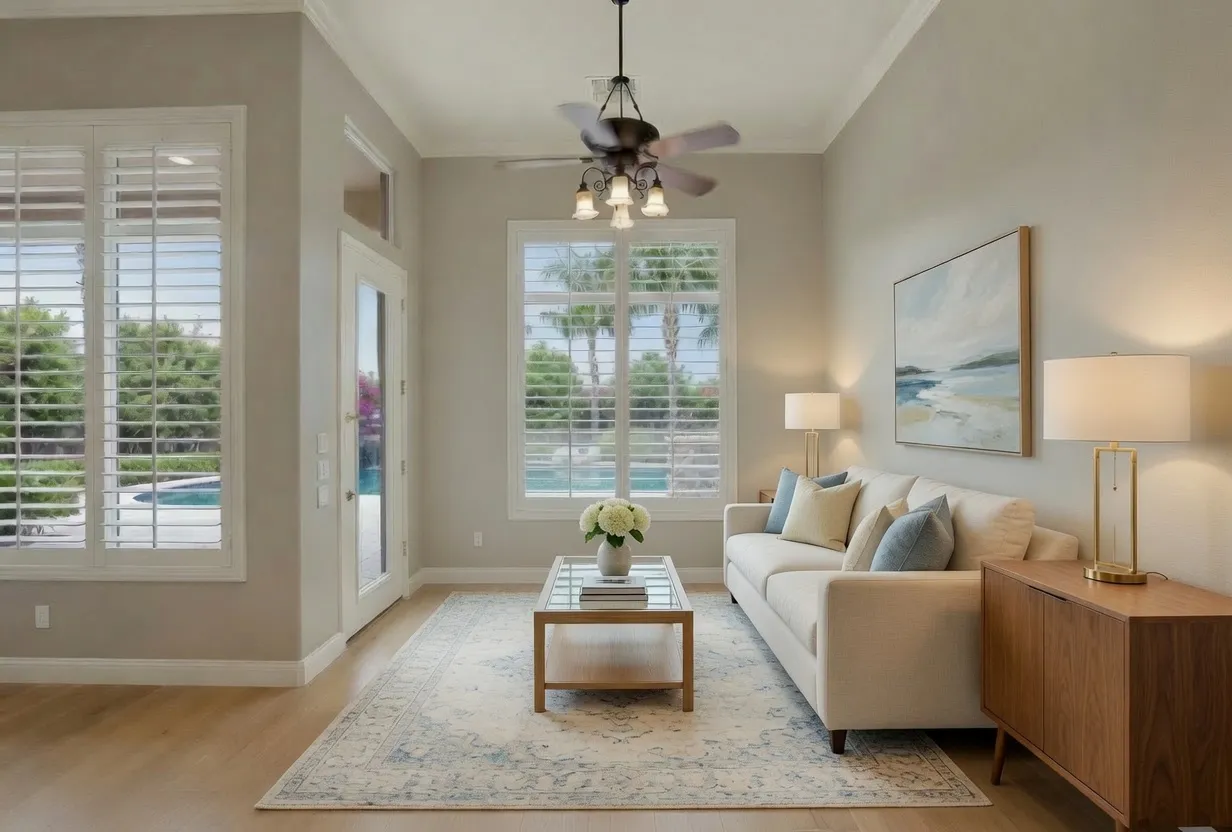
Side-by-side comparison
| Factor | Plantation Shutters | Window Film |
|---|---|---|
| What it is | A window treatment | A glass upgrade |
| Heat rejection | Strong - rigid panel + dead-air insulation | Good - always-on solar rejection at the glass |
| UV / fade protection | Blocks when closed or tilted | Near-total, constant - film's best trick |
| View impact | Louvers open to the view | None - invisible |
| Light control | Louver-precise, hour by hour | None - fixed, permanent |
| Privacy - day | Adjustable | Partial (reflective films) |
| Privacy - night | Full, adjustable | Reversed - interior lights make you the display |
| Insulation at night / winter | Works around the clock, both seasons | Minimal once the sun's down |
| Interior design | A feature of the room | Invisible - adds nothing |
| Resale | Permanent upgrade that conveys | Rarely noticed; aged film reads negative |
| Window warranty | No effect | Can void it - see the fine print section |
| Lifespan | 20+ years, worry-free | Quality films last many years; bubbling/peeling when they age out |
| Best role | The whole job, on the windows you live with | Heat + fade on view glass where no treatment is wanted |
What Film Genuinely Does Well
Fair is fair: a quality solar film rejects a meaningful share of the sun’s heat and screens out nearly all UV — constantly, with no one deploying anything and nothing visible from inside or out. For fade protection specifically, film is the strongest always-on tool there is: UV is the main killer of Arizona floors, furniture, and art, and film blocks it every daylight hour including all the hours your other treatments sit open.
That’s a real capability. It’s also the entire list.
What can’t window film do?
Privacy - and the night problem
Daytime reflective privacy reverses after sundown: with interior lights on, film-only windows put the room on display. Every evening, you need something else at that glass anyway.
Light control
Film is one fixed setting, forever. It can’t kill the 5 PM glare off the TV without also dimming the December morning. A louver moves; film doesn’t.
Night and winter insulation
Film’s work is solar. Once the sun’s down it does close to nothing for the heat leaving (or entering) your home — while a closed shutter insulates around the clock, both seasons.
The room itself
Film adds nothing to how a room looks, feels, or lists when you sell. Shutters are the fixture buyers name.
What’s the real story on film and window warranties?
Here’s where most comparisons go wrong — window-treatment sites scare-monger it, film sites bury it. The accurate version has two halves:
Half one: film can void your window manufacturer’s warranty. Film changes how glass absorbs heat, and many window manufacturers exclude damage on filmed glass — thermal stress cracks and seal failures on dual-pane units are the concern.
Half two: many film manufacturers will cover the window warranty themselves if their film voids it. Reputable film makers know half one, and their answer is to stand behind the glass — matching the window warranty their product displaced.
So the practical guidance isn’t “never tint” — it’s get the film manufacturer’s window-warranty coverage in writing before installation, and confirm what it covers and for how long. If an installer can’t produce that documentation, that tells you what you need to know. (Shutters, for the record, touch none of this — nothing changes at the glass.)
Where each one wins
The view wall where you want nothing visible
Film's best case: heat and fade protection with the architecture untouched.
Every room you live in
Shutters - because evenings, privacy, glare, winter, and design are all part of the job, and film shows up for none of them.
The fade-critical room - art, wood floors, west sun
Both, honestly: film for the constant UV screen, shutters for the heat, control, and the hours you want the room dark - the full west-facing comparison covers the playbook.
"I just want the house cooler, cheapest path."
Compare film bids against cellular shades and solar screens before deciding - film is rarely the cheapest per window, and each alternative trades differently.
What Arizona homeowners say
“Installer Wyatt did an excellent job. Paid attention to details was extremely supportive ... In addition would also highly recommend sales professional Rob for all your design and planning needs. He was extremely helpful. He walked us thru all available options with care and patience in meeting our particular needs. No pressure tactics, just genuine support.”
“Rob was fantastic from the beginning to the end, and the shades and service were top-notch. If you're new to blinds and shutters, they're great at explaining everything. Highly recommend!”
Frequently asked questions
Is window tint worth it in Arizona?
For view-critical glass where you want no visible treatment, quality film earns its cost in heat and UV rejection. As a whole-home strategy it falls short - it can't do privacy, light control, night insulation, or anything for the rooms' design, so most homes still need real treatments on the windows they live with.
Does window film void window warranties?
It can - many window manufacturers exclude damage on filmed glass. But many film manufacturers will cover the window warranty themselves if their film voids it. Get that coverage in writing before installation; it's the whole ballgame.
Does tint give privacy at night?
No - it reverses. Reflective film that hides your interior by day puts it on display at night once the lights come on. Film-only windows still need a treatment for evenings.
Tint vs. shutters for blocking heat?
Film rejects solar heat at the glass all day; shutters insulate the whole window opening around the clock, including nights and winter, while also controlling light. On the hardest exposures the two stack well - film screening UV constantly, shutters doing everything else.
Does window film stop furniture from fading?
It's the best constant UV screen available - near-total UV rejection every daylight hour. Pair it with treatments you actually close during peak sun and fade protection gets close to complete.
Can you put shutters over tinted windows?
Yes, with no conflict - the film works at the glass, the shutter works at the opening. It's a common combination on fade-sensitive, sun-facing rooms.
Get the straight answer for your glass
If film belongs on some of your windows, we'll tell you - it's not what we sell, which makes us a decent referee. The consultation maps heat, fade, privacy, and light room by room, and specs the treatments where treatments win.
Serving the Phoenix Valley from our Gilbert, Peoria, and Scottsdale showrooms.