
Plantation Shutters vs. Shades: Cooling Costs, Light Control & Style
This is the comparison where Arizona homeowners get the most conflicting advice, because both sides have a real case. Cellular shades genuinely insulate well. Shutters genuinely last longer and control light more precisely. We sell and install both, so we don't need to spin this one - here's how they actually stack up when the meter is running in August.
The quick verdict
Shutters are the backbone of most Arizona homes we design: they last 20+ years, insulate the window with a rigid barrier and dead air, and give you louver-precise light control that no shade matches. Shades earn their place in two roles - view-critical windows, where a solar shade cuts glare and heat while keeping your mountain or golf-course view, and layered looks, where a soft shade adds warmth shutters alone don't. Cellular shades are the strongest shade for pure insulation, and for some rooms they're the right call. Most homes shouldn't choose one or the other - the best answer is usually shutters as the default, shades where the view or the design calls for them.
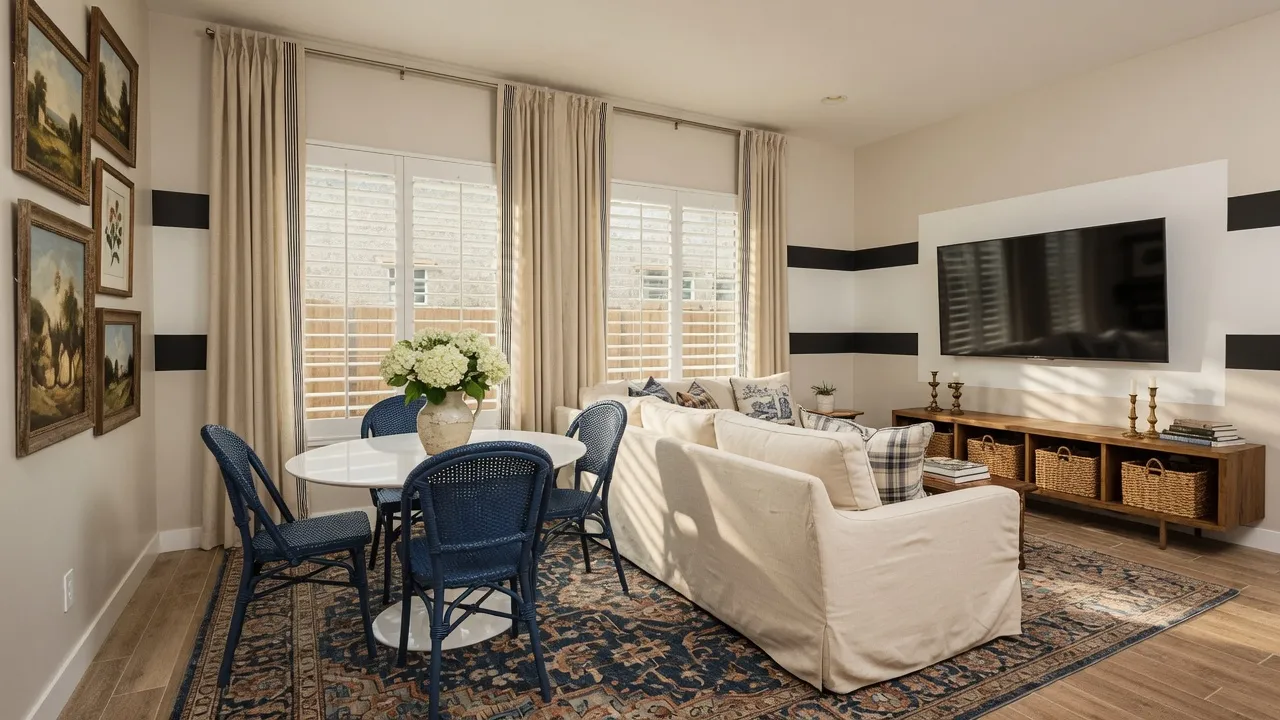
Side-by-side comparison
| Factor | Plantation Shutters | Shades |
|---|---|---|
| Insulation / cooling impact | Excellent - rigid panel plus dead-air pocket at the window | Cellular: excellent (honeycomb air cells); roller/solar: moderate |
| Light control | Louver-precise - dial in any amount of light, any angle | On/off or partial raise; solar shades filter but don't block |
| View preservation | Louvers open to a view but frame it | Solar shades win - glare and heat cut with the view intact |
| Lifespan in Arizona | 20+ years | 5-10 years typical; sun-side fabrics fade and degrade faster |
| Sun fade resistance | High (quality polymer especially) | Fabric fade is the main aging mode on Arizona exposures |
| Cleaning & monsoon dust | Wipe clean | Fabric holds dust; cellular cells can trap it |
| Kid & pet safety | No cords | Cordless and motorized options solve this; corded models don't |
| Motorization | Limited (tilt options) | Excellent - the natural motorization product |
| Style range | Classic, architectural, permanent | Huge fabric/texture/color range, easy to update |
| Resale value | Fixture that conveys and adds value | Treated as decor, not an upgrade |
| Upfront cost | Higher | Lower to comparable (motorized narrows the gap) |
| Best use case | Whole-home default, bedrooms, living areas | View windows, layering, hard-to-reach and specialty glass |
Which insulates better: cellular shades or shutters?
Over an Arizona summer of actual daily use, shutters — though the cellular shade’s physics is real. Honeycomb cells slow heat transfer and test very well in a national-average climate, which is exactly why they’re marketed so hard on insulation. So why do we still put shutters on most Arizona windows?
Three reasons. First, a shutter is a rigid barrier mounted tight to the frame, creating a still-air pocket in front of the glass — where Arizona heat gain actually happens — and it holds that seal identically in year one and year fifteen. Second, insulation only works when the treatment is deployed: a cellular shade insulates when it’s down, and most people don’t live in the dark; shutters insulate closed and let you meter light in through tilted louvers at the same time. Third, longevity is part of the energy math — a shade that fades and gets replaced twice over a shutter’s life isn’t cheaper, and it spends part of that life degraded.
Where cellular shades genuinely win: windows you want softly filtered light through all day, and budgets where covering every window well today beats covering half of them premium.
Which gives you better light control?
A shade gives you positions. A shutter gives you a dial. Tilting louvers means cutting the western glare off the TV without darkening the room, blacking out a bedroom at noon, or bouncing light off the ceiling instead of into your eyes — adjustments a raise-and-lower product structurally can’t make. If a room’s light changes character through the day (in Arizona, that’s most rooms), this is the difference you feel daily.
The exception is total blackout: a shutter alone leaves thin light lines at the louver edges, so for media rooms and shift-worker bedrooms, a blackout shade — or a shutter-plus-shade layer — beats either alone. (More on that combination in our shutters vs. motorized shades comparison.)
When are shades the right call?
- View windows. A solar shade cuts glare and a large share of heat gain while keeping the view — the product built for the picture window facing the Superstitions or the golf course.
- Hard-to-reach and specialty glass. High clerestories, wide sliders, patio walls — shades (especially motorized) handle glass that shutters can’t practically cover.
- Layered design. A shutter with a soft roman or woven-wood shade above adds texture and warmth. Increasingly popular in Arizona interiors.
- Fast-refresh rooms. Nurseries and kids’ rooms where you may want the look to change in five years — fabric is easy to swap; shutters are permanent.
Which is right for your home?
Bedrooms
Shutters - with a blackout cellular behind them if you need true darkness. Precise light control plus insulation where you sleep.
The great room
Shutters as the anchor. If it has a view wall, solar shades on the view glass, shutters everywhere else.
Kitchen and baths
Shutters (polymer). Steam and splash are hard on fabric.
The west-facing office
Shutters for the glare dial; a solar shade if the window is the view.
Rental or short-horizon budget
Quality shades cover more windows for less today. Just know you're choosing a 5-10 year product, not a 20-year one - the honest version of "cheaper."
What Arizona homeowners say
“Southwest Blinds and Shutters was a delight to work with from beginning to end, from salesperson to installer. They stayed in communication with me throughout the process, and we actually got our shutters sooner than I expected! John arrived early and worked efficiently, but carefully, to install my whole house in about 4.5 hours. He was very personable and kind. My shutters look amazing! Happy customer :)”
“Had a great experience with Southwest Blinds. From design to installation, the team is professional punctual and the shutters, roller and roman shades look fantastic. Highly recommend them for quality work and excellent customer service. Shout out to Louie, Bill, Wyatt and Rob!”
Frequently asked questions
Are cellular shades or shutters more energy efficient?
Both perform well. Cellular shades insulate through honeycomb air cells but only while lowered; shutters create a rigid, sealed air pocket at the glass and insulate even while metering light through tilted louvers. Over an Arizona summer of actual daily use, shutters typically deliver more real-world benefit - and they hold that performance for decades instead of fading out.
Do shades fade in Arizona sun?
Fabric fade is the main way shades age here, especially on west- and south-facing windows. Solar-rated fabrics resist it best; standard fabrics on hard exposures can show fading in a few years.
Can you combine shutters and shades?
Yes, and it's one of our most common designs - shutters for structure and light control, with a blackout shade for total darkness or a soft shade for texture. It's also the answer for view walls: shutters through the home, solar shades on the view glass.
Are shutters or shades better for resale?
Shutters. They're a permanent fixture that conveys with the home and reads as an upgrade to buyers. Shades are treated as decor.
Which is safer for kids and pets?
Shutters have no cords at all. Shades are safe in cordless or motorized versions - if you have young kids, corded shades shouldn't be in the house.
Which costs more?
Shutters cost more upfront. Over 15-20 years, replacing shades once or twice typically closes most of the gap - the comparison is really "pay once" vs. "pay less, more often."
Design the right mix
Because we install both, the consultation isn't a pitch for one product - it's a window-by-window plan: shutters where they belong, shades where they win, and straight answers on what each choice costs now and over time.
Serving the Phoenix Valley from our Gilbert, Peoria, and Scottsdale showrooms.