
Which Louver Size Is Right for Your Windows? 2½", 3½", and 4½" Compared
Louver size is the decision most homeowners don't know they're making until the design consultation - and it changes the character of a shutter more than almost anything else. Same material, same frame, same color: a 2½" louver reads traditional and tailored, a 4½" louver reads open and contemporary. Here's how to choose, including the part that's specific to Arizona light and Arizona views.
The quick verdict
Here's the design shortcut we use in every consultation: start with your ceiling height. It's the room-scale reference your eye judges everything against, and it gets you to the right louver faster than any other rule. In an older Arizona home with 8' ceilings, 3½" is almost always the answer - a 4½" louver in that room feels too substantial and out of balance, even though it technically shows more view. In the modern mid-level Arizona home with 9' ceilings, 3½" and 4½" both work beautifully. In upper-end homes with high ceilings, 4½" is what looks balanced - smaller blades get lost in the volume. And 2½" we reserve for very traditional, smaller homes, where the classic colonial proportion matches the architecture. Louver size is a balance decision before it's a view decision - and ceiling height is where balance starts.
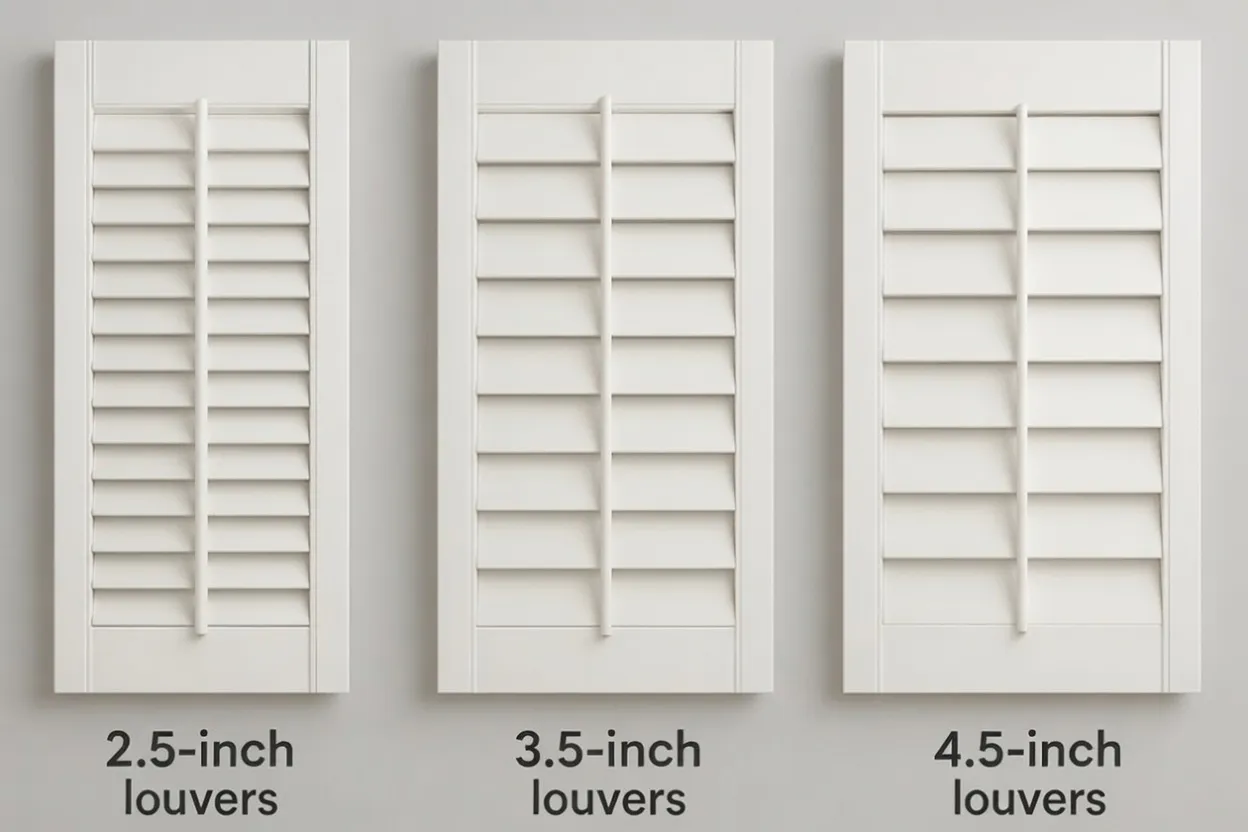
Side-by-side comparison
| Factor | 2½" Louvers | 3½" Louvers | 4½" Louvers |
|---|---|---|---|
| Style character | Traditional, tailored, classic colonial | Contemporary-classic, the modern standard | Open, dramatic, contemporary |
| View when open | Most interrupted - more slats per panel | Balanced | Most open - fewest slats in your sightline |
| Light when open | Least | Balanced | Most |
| Best ceiling height | Smaller traditional homes | 8'-9' ceilings - the workhorse | 9'+ and high-ceiling homes |
| Best window sizes | Small to medium windows | Nearly all windows | Large windows, great rooms, tall glass |
| Horizontal lines per panel | Most (busiest look) | Moderate | Fewest (cleanest look) |
| Closed appearance | Fine, detailed texture | Balanced | Bold, wide blades |
| Typical era pairing | Historic, traditional, cottage | Transitional and newer builds | Modern, desert contemporary, custom |
How does Arizona light change the louver choice?
Two local realities push Arizona homes toward larger louvers more often than the national average.
The view math. Every louver edge is a line across your glass. On a window facing desert landscaping, the Superstitions, or a golf course, a 4½” louver puts roughly half as many lines across that view as a 2½” louver. Open the panel or tilt the louvers flat, and the bigger blade simply gets out of the way more.
The low-sun dial. Arizona’s brutal light isn’t midday — it’s the low western sun from late afternoon on, coming in nearly horizontal. Louvers handle low-angle light by tilting to intercept it, and a larger blade gives you a wider working range: you can knock down horizontal glare while still holding a meaningful view and daylight. Smaller louvers reach “closed enough” sooner, taking the room darker than you wanted just to kill the glare.
Neither point makes small louvers wrong — it means Arizona gives you an extra reason to size up within the range your ceiling height allows. The view argues for bigger; the room decides how big — and the ceiling-height rule decides the room.
Which louver size fits your ceiling height?
After thousands of Arizona installations, the tool we reach for first is simple: ceiling height. Most louver guides tell you to match louver size to window size — that’s a piece of it, but it’s the second check, not the first. The ceiling sets the scale of the room, and the room is what your eye judges the shutter against.
Here’s how it maps onto Arizona homes:
- 8’ ceilings — the older Arizona home. A 4½” louver in an 8’ room feels too substantial, out of balance with everything around it — and here’s the counterintuitive part: that’s true even though the larger louver technically provides more view. Balance beats specs. In these homes, 3½” is almost always the better choice, and 2½” enters the conversation for very traditional, smaller homes where the classic proportion suits the architecture.
- 9’ ceilings — the modern mid-level Arizona home. This is where the choice genuinely opens up: 3½” and 4½” both sit well in the room’s scale, and the decision comes down to style direction and how much the views matter.
- High ceilings — the upper-end Arizona home. 4½” is what looks balanced. In a room with 10’, 12’, or vaulted ceilings, smaller louvers read busy and undersized against the volume — the bigger blade matches the scale of the space.
Window size still matters as the second check — louvers should also sit sensibly on the glass itself, and a small powder-room window may step down a size from the rest of the home. But start with the ceiling, and you’ll be right far more often than starting with the window.
One consistency note: keep louver size uniform within any room, and ideally along any sightline where multiple windows read together. Mixing sizes room-to-room is fine and common; mixing within one view is what looks like a mistake.
Which is right for your home?
Older ranch or block home with 8' ceilings
3½". The room's scale can't carry a 4½" blade gracefully, view or no view - and the result will look right every time.
Very traditional, smaller home
2½". The classic proportion belongs to this architecture; it's the one place we still spec it regularly.
2000s-built home with 9' ceilings, whole-house project
Your choice genuinely opens up: 3½" throughout is the safe classic; 4½" in the great room and view-facing rooms if you lean contemporary. Both are balanced at this ceiling height.
Upper-end home with high or vaulted ceilings
4½". Smaller louvers get lost against the volume; the larger blade matches the scale - and you get the view benefit as a bonus.
Mixed ceiling heights in one home
Common in Arizona two-stories and split levels. Size by room, following each room's ceiling, with consistency along shared sightlines. We'll map it window by window at the consultation.
What Arizona homeowners say
“All the measurements for installation were perfection... Answered all my questions gave me advice on how to open and close for the best Lighting and privacy. Southwest blinds certainly have the greatest employees.”
“Wonderful process from start to finish - designer came in home ensure color matching. Installation team super fast, polite, detail oriented feel like a brand new home.”
Frequently asked questions
What's the most popular louver size?
3½" - it's the modern standard and what we install most often. 4½" is the fastest-growing choice in Arizona, driven by larger windows and view-oriented floor plans.
Do bigger louvers cost more?
No - louver size doesn't change the price of our shutters, so the decision is purely about design and view: pick the size that balances your room, not your budget.
Does ceiling height matter for louver size?
It's the first thing we look at. 8' ceilings call for 3½" (a 4½" blade feels too substantial in that room scale, even though it shows more view); at 9' both 3½" and 4½" work; in high-ceiling homes 4½" is what looks balanced.
What size louvers for large windows?
Usually 4½" - but check the ceiling first. A large window in an 8' room still reads best at 3½"; a large window under high ceilings is 4½" territory without question.
Are bigger louvers better for light control?
They give you a wider working range against low-angle sun - useful for Arizona's western glare - and fewer seams when fully closed. Smaller louvers still close fully; the difference is in how much view and daylight you keep while managing glare.
Can I mix louver sizes in one house?
Yes, and most whole-home designs do - by room, scaled to the glass. The rule is consistency within a room and along shared sightlines.
What louver sizes are available?
2½", 3½", and 4½" cover nearly every home. We'll help you match the size to each room at the consultation.
See all three on your actual windows
Louver size is hard to judge from photos and easy to judge in person. At a free in-home consultation we bring samples, hold them to your windows and your light, and map sizes room by room - so you choose from what you can see, not from a chart.
Serving the Phoenix Valley from our Gilbert, Peoria, and Scottsdale showrooms.